

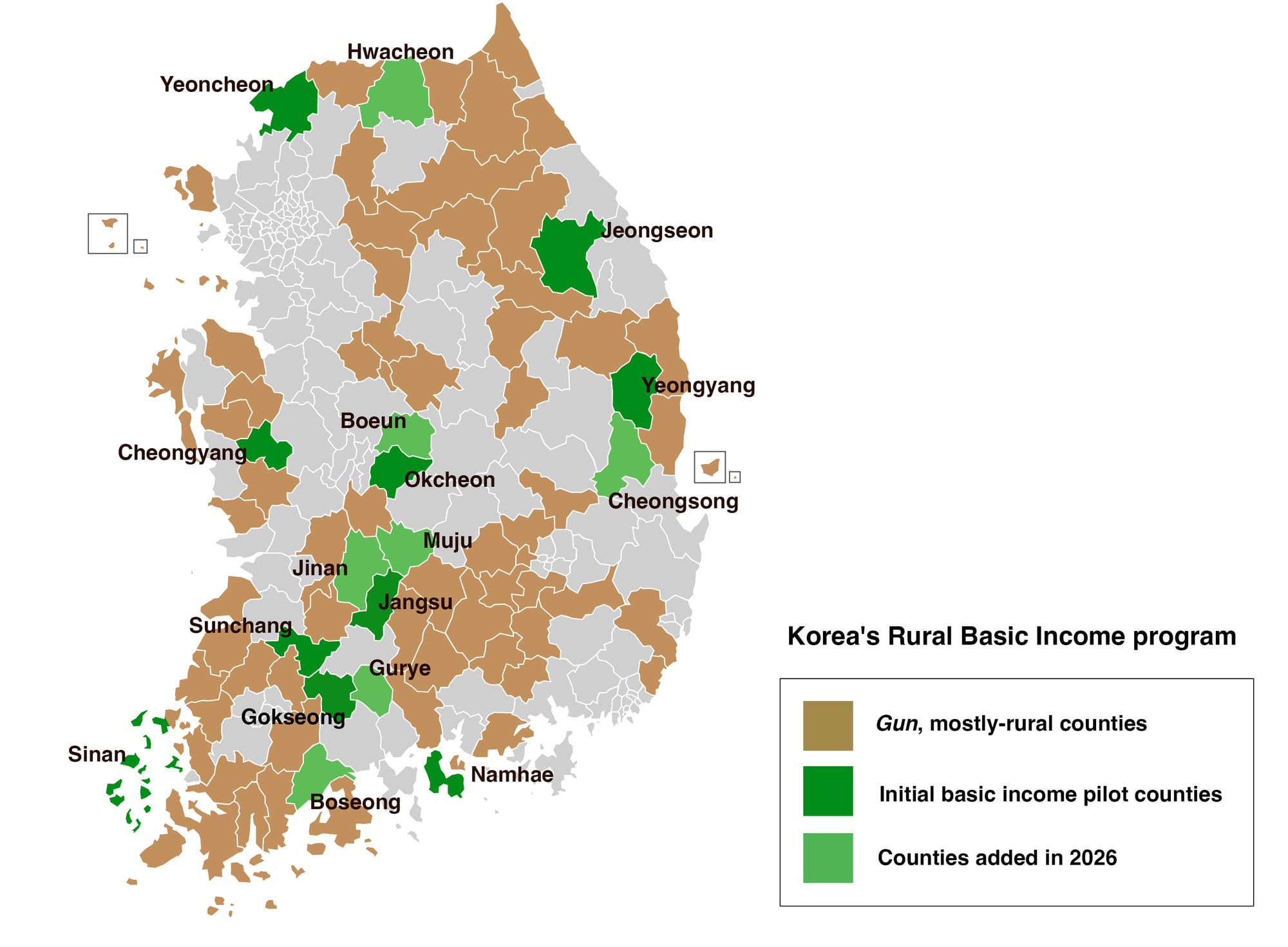
Staring down a demographic cliff and the declining population of country heartlands, South Korea’s Ministry of Agriculture, Food and Rural Affairs (MAFRA) is extending its monthly Rural Basic Income pilot across 17 rural counties. The aim is to show that guaranteed income is a powerful tool for community survival and economic recovery.

The program is unconditional and individual, bypassing the administrative blind spots and busy work of traditional selective welfare programs. Rather than unrestricted cash, payments are issued as regional vouchers, generally usable within locally defined living zones centered on the resident’s town or township — a measure intended to encourage local business.
As outlined in the campaign’s original announcement, recipients receive ₩1 million each year, with an additional ₩1 million annually for people aged 19–29, bringing their total to ₩2 million annually.
Basic income programs mark a change in rural development strategy in Korea away from physical infrastructure like roads and bridges and toward personal support. By directly supporting rural living, the government hopes to keep essential services like schools and clinics from reaching their breaking point.
Data from the initial pilot regions suggests that this economic gamble is paying off. In the first ten pilot counties, MAFRA reported a 4.7% increase in population and a 13.7% rise in registered participating merchants after the program’s introduction. In Yeongyang County, the ministry reported a 5.2% population increase. These are promising early administrative indicators, although a formal impact evaluation is still pending.
“With the rural basic income pilot programme in place, we will make the utmost effort to ensure that rural areas grappling with declining populations can be revitalized and become rural communities where people want to return and reside.” — Minister Song Mi-ryung, Ministry of Agriculture, Food and Rural Affairs
MAFRA’s press release highlighted Yeongyang County, where Minister Song Mi-ryung toured dwelling renovated to house rural residents and foreign workers. In Okcheon County, the population returned to 50,000 residents after the county was selected for the pilot, a turnaround local officials directly attribute to the RBI’s ability to stabilize household finances and encourage settlement. The threshold was reached before the first payments were distributed, though, predating any direct economic effects of the transfers themselves.
Officials hope they will generate a cycle of economic activity, encouraging locals to support retailers, in turn making the community more attractive to new residents.
President Lee Jae-myung has advocated making the experiment permanent and has proposed using growing rural special-tax revenue to help finance it. In his 2021 presidential campaign, Lee pledged to phase in annual basic-income payments of ₩1 million for every citizen by the end of the next presidential term, beginning with ₩250,000 in 2023; people aged 19–29 would receive an additional ₩1 million annually.
MAFRA, however, states that permanent implementation and further expansion remain undecided.
“Instead of using this budget for infrastructure like rural roads and bridges as before, we can allocate it as funding for the rural basic income,” Lee stated, as translated by The Chosun Daily.
If the United States has been slow to realize that income support increases local spending and encourages local growth, the Korean plan is quite similar to the Rural Guaranteed Minimum Income Initiative, currently providing a higher monthly benefit of $1,500 to residents of three rural counties in WV, NC, and MS.
Both programs choose geographically isolated counties plagued by generational poverty and decline, and gather evidence-based scientific data to show that direct cash is an efficient and dignified way to revitalize communities left behind by economic change.
“Even though the rural basic income was introduced temporarily for two years, it has already shown this level of effect. If we make it permanent and increase the amount, wouldn’t the impact be much greater?” — President Lee Jae-myung